Artificial turf vs natural grass in Kentucky
Including the cases where we would tell you to keep the lawn you have.
Including the cases where we would tell you to keep the lawn you have.
A typical Lexington homeowner spends $700 to $1,400 a year maintaining a lawn: mowing, water, fertiliser, weed control, autumn aeration and overseeding. Across fifteen years that is $10,500 to $21,000.
A $6,000 turf installation with a fifteen to twenty year life amortises to roughly $300–$400 a year with effectively no recurring spend. Break-even usually falls between year seven and year ten.
Turf wins on consistency. It looks the same in February, in August drought, and under the maple where grass has never grown. Natural grass at its absolute best — a well-watered, well-fed lawn in May — still looks better than turf. The question is how many weeks a year yours actually looks like that.
Our climate is genuinely hard on cool-season grass. Fescue struggles through July and August heat, then the clay subsoil holds water through spring. Add mature tree canopy across much of Lexington and a large share of yards have areas where grass simply will not establish.
Honest version: it depends what you weight.
Turf advantages: no irrigation, which matters in drought years. No fertiliser or pesticide runoff into the watershed. No mower emissions.
Turf disadvantages: it is a petroleum product. It does not sequester carbon, support insects, or cool the air the way living plants do. It has a finite life and disposal is imperfect, though recycling has improved.
A reasonable position: turf makes environmental sense for areas that are already failing — shaded ground, worn dog runs, slopes eroding into the street. Converting a healthy, thriving lawn is a harder case to make.
We would rather say this than sell you something you will regret:
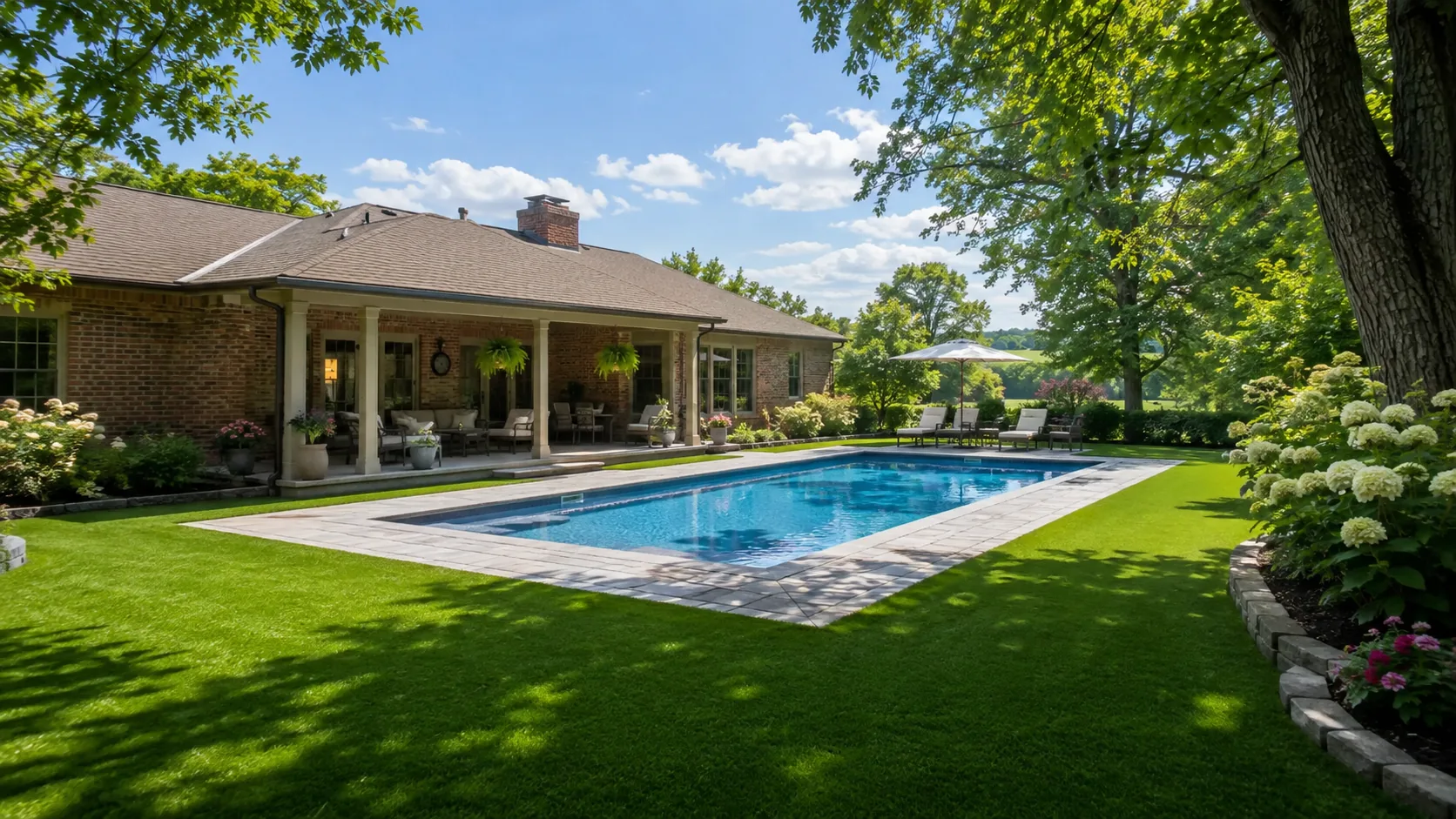
Most of our work is not whole-yard conversion. It is the dog run, the shaded strip, the slope, the pool surround — the specific areas that fail every year — with natural grass kept where it does well. That is usually the right answer and it costs considerably less.
Most estimates are scheduled within 48 hours.
Tell us the space and we’ll give you a firm, written price. No pressure, no obligation.