Turf drainage over Kentucky clay
The reason an installation method that works in Arizona fails in Fayette County.
The reason an installation method that works in Arizona fails in Fayette County.
Turf backing drains at over 30 inches per hour. That statistic gets quoted constantly and it is close to meaningless on its own, because water leaving the turf still has to go somewhere. In Lexington, what it lands on is clay.
Central Kentucky soils are clay-heavy. Clay particles are fine and tightly packed, so infiltration rates are extremely low — often a fraction of an inch per hour against sandy soil's several inches.
Practically: water passes through the turf quickly, hits the clay, and stops. If nothing carries it away it sits in the base, saturates it, and on freeze-thaw cycling that saturated base heaves. That is where ruts, low spots and soft patches come from two or three winters later.
The subgrade is shaped to fall away from the house toward an outlet. Even a small consistent grade moves a lot of water over a season.
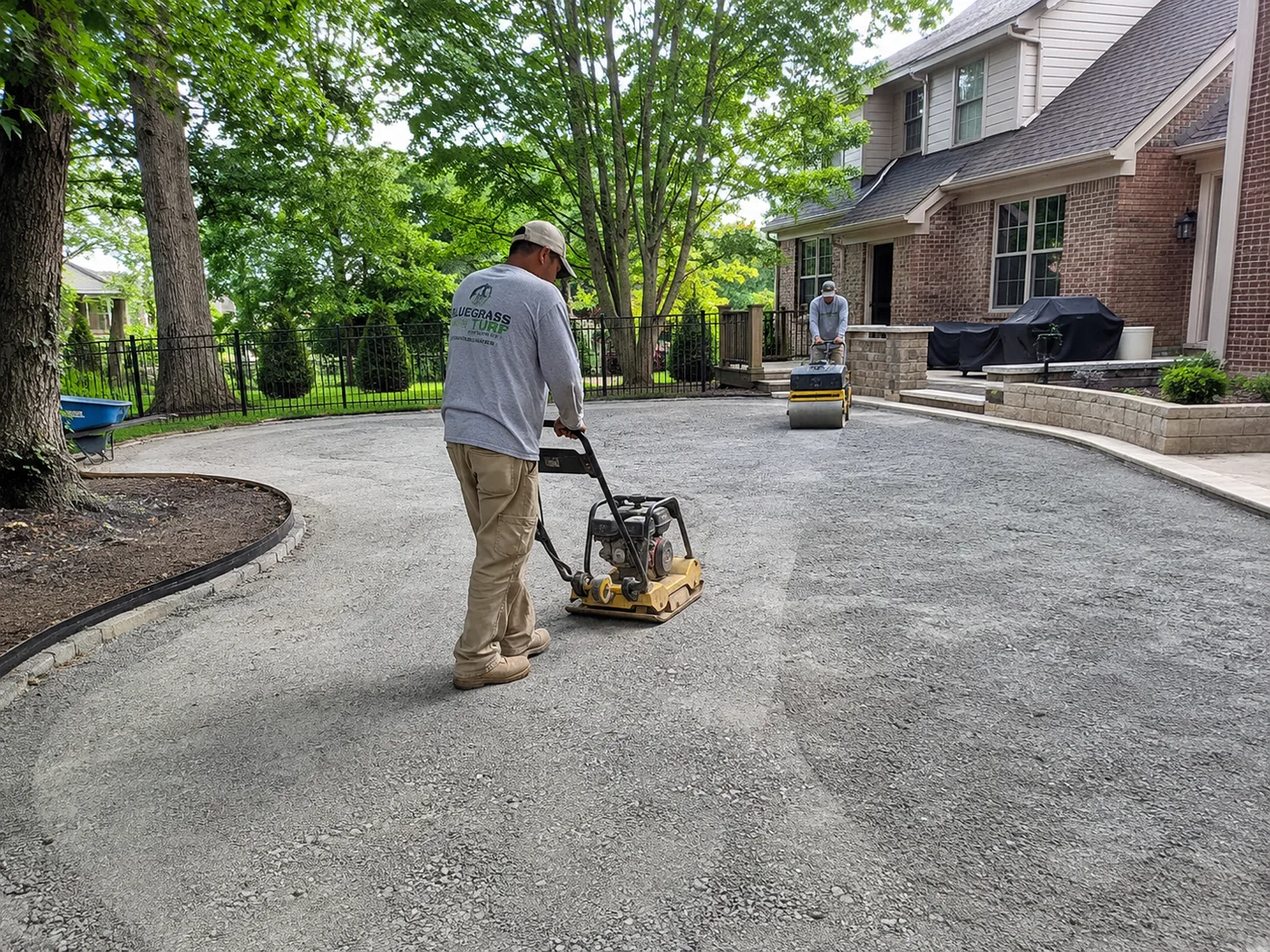
The base uses angular crushed stone with void space, which stores water temporarily and lets it travel laterally rather than pooling.
Yards that sit low, or take runoff from a neighbouring slope, get drainage built in: a French drain along the low edge, a dry well, or a tie-in to existing site drainage. This is an extra cost and we itemise it rather than burying it.
Compacting the base in layers gives uniform density. A single deep layer compacts only at the surface, leaving soft material underneath that later settles.
Lexington cycles across freezing repeatedly through winter. Water in a saturated base expands as it freezes, lifting the material above it, then leaves a void when it thaws. Repeated over several winters this is what produces the wavy, uneven turf you occasionally see on older installations. A base that drains does not hold the water that drives the cycle.
An installer who cannot answer these is quoting turf, not an installation.
Most estimates are scheduled within 48 hours.
Tell us the space and we’ll give you a firm, written price. No pressure, no obligation.